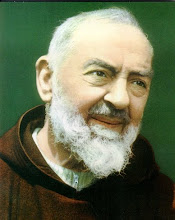
Hello, everyone! We haven't been posting in a while, and for those few of you who have been waiting for a new post, I do apologize. Truth be told, I simply haven't had much time. As you may recall, my graduation (and Ana's) is coming up, and I (we) am (are) swamped with school and preparations! It doesn't leave much time to write, or to format posts. And formatting the posts is becoming increasingly difficult. You might have noticed missing spaces in my paragraphs, misplaced pictures; and, to add to that, blogger just changed their dashboard. I'm going to have to re-learn how to use it. (I'm thinking of switching to another blog host, but that will be in the distant future, if at all. If you have any advice, it would be greatly appreciated.)
Anyway, to get to the point; I'm sorry for keeping you waiting. I will try to post the rest of the mini-meditations soon, and some other posts. Thank you for your patience!
In the meantime, please stop by this blog:
The Perky Pilgrim
This perky girl has some beautiful and inspirational musings.
Monday, April 23, 2012

Saturday, April 7, 2012
The Right Choice and the Wrong One
At my talk to the Confirmation and Highschool students the other day, I was asked two very interesting questions by a young fellow discerner.
The first was: "How do you know if you have made the right choice about your Vocation?"
Well...I haven't personally found "the right choice" yet, as I am still discerning. I've heard some Vocation-Decided people say that "You just know." Does that answer your question?
...Yeah, it didn't cut it for me, either, and after speaking with some more experienced and eloquent people, I've come to the conclusion that the greatest sign that you have discovered your calling is: Peace. Not happiness, or contentment, or even superficial fulfillment, but peace. A deep abiding sense of rightness, like everything fits. I mean, think about it. God knew what you were going to do, and what He wanted you to do, before He even created you. He would never create you to be bad at what He plans for you to do, and He would not force you to do something that you are not made for. You and His Plan are going to fit together like two puzzle pieces. So, when you find your fit, when you make "the right choice," you will JUST KNOW, the same way you will JUST FIT.

The second question was: "What if you make the wrong choice?"
I firmly believe that the only wrong choice you can make is to refuse to trust in God and so not truly discern. If you don't trust in God and decide to make your own way in the world, you are setting yourself up for failure.

(...No, Self, it's not that I don't love you. It's just that you are a fallible human being, and making eternity-affecting decisions isn't your strong point. I'm sorry, but this Me, Myself, and I relationship isn't going to work...)
I firmly believe that as long as you trust in God, you will have nothing to worry about. Place all
your trust in him, and He will not let you down, because that is not the way He works.
your trust in him, and He will not let you down, because that is not the way He works.
("What are you doing Father?"
"I'm looking at that human down there. It's trusting in me."
"Let's play a game with it!"
"...Alright, Son, what shall we do?"
"Oh, I know! We will throw it into the world and let it fend for itself. Oh, irony abounds!"
"That's a great idea, Spirit. Should we give it a hint?"
"No!"
"No!"
"Yes!"
"Okay, I'll give it a hint. Hey, human:

"Hehehe, pathetic humans!")
That sounded funnier in my head, but you get the point. God will not fail you as long as you trust in Him. You won't have to worry about choices; you will be incapable of making "the wrong choice," because HE is incapable of making the wrong choice.
Now, what happens if you do not trust in Him, decide to do your own thing, and end up doing something you weren't created to do? Well, all is not lost. There is not a single situation on this
earth, past present, or future, that God is incapable of--some way, somehow--turning to His advantage. He can turn the worst of situations into a good situation. Sometimes, He will even make you holy in spite of yourself. But still...why go through the trouble? Why make a bad situation into a good one when you can be making a good situation into an awesome one? If you haven't made a choice yet, just trust in God now, not later.
earth, past present, or future, that God is incapable of--some way, somehow--turning to His advantage. He can turn the worst of situations into a good situation. Sometimes, He will even make you holy in spite of yourself. But still...why go through the trouble? Why make a bad situation into a good one when you can be making a good situation into an awesome one? If you haven't made a choice yet, just trust in God now, not later.
Confirmation is like Graduation
 High school graduation is a time of celebration. Twelve tortuous years in the classroom have been successfully completed, and you joyously proclaim your praiseworthy accomplishments, your success, and the death knell of the formidable Institution. No more school, no more
books, no more of teacher's dirty looks! Over and done with, in saecula seaculorum.

Yet it is also a time of nervousness, apprehension, and excitement, for what is the number one question high school seniors are asked? (No, it isn't what parties they will be attending, young man)

The question is: "What college are you going to?"
(So much for the death of the Institution....-.-)
But that simple question, so often asked, reveals the second and truer purpose of high school graduation. It isn't about looking back, and it isn't about the end. It is about looking forward to a new beginning. It's about the future: your future. And the query looms: what are you going to do
with your life? You are an adult now, ready to take on responsibility, decide who and what you are going to be, and make something of yourself. It's not your parents' job to get you out of bed in the morning anymore, it's yours. Scary and exhilarating at the same time, isn't it?
with your life? You are an adult now, ready to take on responsibility, decide who and what you are going to be, and make something of yourself. It's not your parents' job to get you out of bed in the morning anymore, it's yours. Scary and exhilarating at the same time, isn't it?
It's almost Easter. I'm staring at my own high school graduation right now, at the same time
many other teenagers are staring at their Confirmation. I had to talk to some of these teenagers the other day, and the juxtaposition of events got me to thinking.
many other teenagers are staring at their Confirmation. I had to talk to some of these teenagers the other day, and the juxtaposition of events got me to thinking.
Confirmation is like graduation.
After your Confirmation, you become an adult in the Church. You take on the full responsibility of being Christian, and being a soldier for Christ. And once again, the biggest question mark is: what are you doing to do with your life? What is your place as an adult in the Church? How are you going to fulfill the call to sainthood? What does God want you to do? Just as the year of your high school graduation is the first step in finding your place in the world, the year of your Confirmation should be a large step in finding your place in the Church. Your Confirmation, therefore, is an excellent time to begin taking some serious time out to discern your
Vocation.

Sometimes, that's easier said than done. If finding the right college can be confusing, discernment is even more so! So, here is a quick guide to beginning discernment (as tested by moi):
1. Be Open. I really, really can't stress enough. Discerning your Vocation is asking God, "What do you want me to do?" If you intend to ignore that answer when He gives it, that defeats the entire purpose of discerning.
2. Challenge Your Assumptions. "I already know I'm going to get married." I've heard those words so many times! And while some people know what God is calling them to do from a young age (Padre Pio being an example) most people do not. Imagine if everyone just assumed they were going to be a dentist when they grew up, because their parents were dentists, or because they said they were going to be a dentist when they were three! While there is definitely nothing wrong with being a dentist, when you just assume that you are going to be one, you cut yourself off to a world of possibilities. It's the same with Vocation. How do you know for certain you are called to marriage (or religious life) if you have never even learned and looked into your other options? I used to assume that I was going to get married and be a famous author, but once I stopped clinging to that idea and allowed myself to really learn about religious life, I found that I really liked it. You might, too.
3. Talk to People and Ask Questions. Go to a priest and ask him what drew him to the priesthood. Go to a holy, married couple and ask them what is the best thing about
marriage. Go to a nun or consecrated single and ask them what they do. Hearing about the experiences of others is always helpful. And though I hesitate to challenge the wisdom of the elders, it has been my personal experience that curiosity does NOT kill the cat; it doesn't hurt to ask questions, and it will give you a real feel for what the different Vocations are actually like.
And you are bound to hear lots of funny stories, as a much-appreciated plus.
4. Research. Some excellent resources for Marriage and the discernment of it are:
BadCatholic (You might have to do some sifting, but this guy has several amazing posts on marriage; just don't get distracted by the awesome pictures)
And Nic's Blog, on the sidebar (to get a taste of how marriage and Faith fit together)
Some resources I've found helpful for learning about the religious life are:
And some of the blogs on the sidebar.
There are many more for both Vocations, but that would be a series of blogposts in itself!
5. Pray. Pray, pray, pray. Discernment can't happen unless you establish a dialogue with God; how else are you to ask and He to answer? So, grab your Rosary, your Bible, and your book of Novenas, and head off to Adoration.
6. Find a Spiritual Director. Sometimes, it is difficult to hear the voice
 of God over the clamoring of our own wills. Sometimes, it is difficult to hear God, period! A Spiritual Director can help you with that. A Spiritual Director is a holy person who can advise you, support you, and pray with you and for you. They help you when discernment gets hard and your thoughts (or feelings) become more tangled than Rapunzel.
 One last quick piece of advice: you do not have to be extremely holy to discern. I've met people who say, "Oh, I could never be a nun/priest/what-have-you because I'm not HOLY enough." And that statement completely misses the point of discernment and of Vocation. It seems to have forgotten that we are all called to holiness. We are all called to be saints. HOW we are going to achieve that is what we do not know, and what discernment is for. Discernment is our search for the life that will make us saints. It asks what God wants of us (which is, in a word, sainthood) and how to achieve it (specific vocation). The very fact that you are discerning, then, admits that you are not holy, and you need God's help and plan to become so. So none of that "I'm not holy
enough." You do not need to be holy to discern. Discerning, if you approach with an open and
trusting heart, will make you holy.
So, no excuses. You are going to be an adult in the Church soon!
enough." You do not need to be holy to discern. Discerning, if you approach with an open and
trusting heart, will make you holy.
So, no excuses. You are going to be an adult in the Church soon!
What are you going to do with your life?
Tuesday, March 13, 2012
Discernment and Friends

“Did you tell your friends?”
This was one of the questions that I was asked during my talk on vocation discernment last month. I’ve decided to post a lengthy answer here.
I did not
 want to tell anyone that I thought God might becalling me to the religious life. The
first reason was because, at the time, I was dating the previously mentioned guy. Telling the guy you are dating and discerning marriage with that you are thinking about taking a permanent vow of celibacy is not my idea of fun. “Boyfriend” and “Nun/Sister” don’t even belong in the same sentence. I was very attached to him, did not want to lose him, and so I didn’t want him to know I was discerning. Cowardly, but there you have it. That was my first reason.
The second reason I did not want to “‘fess up”, is because of a common misconception. I knew that if I told people I was thinking about being a nun, they would expect me to actually
become one. I was fourteen. I knew I wasn’t about to make that sort of commitment. Yet, I did not want to face the failure that others would see in me if I discerned out, and ended up not
becoming a religious. Therefore, I did not want them to know I was discerning.
If they didn’t know, they would have no expectations for me to fail to live up to.
Despite my hesitation, everyone ended up finding out about my discernment. It was growing on me so much and was so surely going to become such a large part of my life, that I was
not comfortable keeping it from my friends. Five days after I turned fifteen, a few of my friends and I found ourselves at a Steubenville youth conference. At the end of the conference, the bishop did a vocation call: anyone discerning the priesthood or the religious life was asked to come up for a blessing. I plucked up my courage, scooted past my two best friends and my boyfriend, and went up. It was a way to tell them, without actually telling them. About a year later I began to actively discern, and my parents told everyone who didn’t already know. Now, everyone knows I am discerning the religious life.
“How do your friends feel? How do they treat you? Did they abandon
you?”
My friends did not even mention my having gone up for the vocation call! They were not the least surprised that I was discerning, and they have since been very supportive and encouraging. One of my friends took the initiative to research the convents I visited, the Orders I was interested in. She went online to their websites to check them out and see where I might pos
 sibly be living in the future. One of my friends sits there and listens when I complain about slow letters, temptations, and the numerous other struggles I have encountered during my discernment. When I’m done dumping on her, she rants to me about how hard it is to
find a gentleman in this modern world who knows how to treat a lady, or how she
likes this guy but doesn’t know if he likes her, etc. Another friend went to visit a convent with
me, and has promised to write me letters and visit me when/if I join. The majority of my friends have taken at least a small amount of time out to discern their vocation themselves. They have decided that God is calling them to marriage, but they love God, and understand that it means to follow Him. I don’t know what I would do without them!

Oh, my fears? Well…
I did not bre
 ak up with my boyfriend right away. It was not until I began to actively discern
(one year after the conference) that we parted ways. My spiritual director—and myself—thought it prudent. The guy is still one of my best friends. He took time out to discern the priesthood after we “broke up.” He has been very supportive, just as much if not more so than my other friends. I know it has been unbearably difficult for him, but he loves me enough to let me
go, and we both find comfort in the knowledge God will make everything come out right if we only trust in Him.
People have assumed that because I am discerning I will definitely become a religious. I’ve fixed this by learning not to care; I’m doing this for God, not for them. I do, however, take every chance to explain to them that discernment is not a commitment. It means that you are learning about your vocational options, that you are taking time out to pray and ask God what He wants for you, and most importantly it means that you are willing to say, “Yes,” when He replies. That’s what discerning means. Nothing more, nothing less. And we are all supposed to discern. We can give God at least as much consideration as we gives colleges, right?

Praying for the Victims
(by Ana Marx)
Different people react to situations differently. Were I a sniveling, cowardly, politically correct person, I would probably present this as my "opinion," but as I'm not, I'm presenting this as fact. I can even prove it using scientific methods! ...Okay, they're just pictures...
 I give you exhibit A: Edward and Bella. For those of you not familiar with the story, in the beginning of the book (before Edward and Bella get so melodramatic that they make soap opera stars look realistic), Edward sneaks into Bella's room to watch her sleep. Let me repeat myself. A strange man sneaks into a 17 year old girl's bedroom. To watch her sleep. Without her knowledge. When confronted with this truth a few weeks later, Bella responds ecstatically and the two go on to become "soul mates."
I give you Exhibit B: What I would do if I were to find an acquaintance had broken into my house to watch me while I slept. This is to be followed with an immediate 911 call, and probably the request of a restraining order. I think it's safe to say that Bella and I reacted differently to the same situation. However, there is something that we both share in regards to out responses: we both reacted with passion.
As a poor, almost-college-student, I have to conserve my money, and sometimes that means making sacrifices. For example, I know I'm going to be doing quite a bit of driving this week (as I have for the past week), so I decided to go to a local Mass that's five minutes from my house, rather than drive two communities over to the parish wehre I usually attend Mass. It's only one time, I thought. I can make it through one of the liberal parish's Masses. At least it's still Jesus.
Though the homly was short, the priest had an excellent point. Jesus could have reacted differently to the money changers in the Temple. He didn't have to get angry to get His point across. After all, this is the Man who (fairly) calmly tolf the Pharisees where they were going if they didn't change their hypocritical ways. This was the Man who consorted with Samaritans and sinful women, gently guiding them to repentance. In our time that would be like Jesus hanging out in the ghetto with gangsters, or chilling in the park with publicly acknowledged cafeteria Catholics.
But He didn't react the way everyone expected Him to on this. Those times where He was correcting people on their behavior; on their lack of respect for God; for their offensive practices; He was able to do so calmly, and without judgment. Until He sees the money-changers in the temple.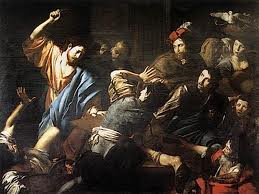
Now, granted, the money changers were blatantly cheating the poor Jews of their coin. History 101:
Because the Jews were under Roman rule, their currency was Roman. However, the money that was to be given to the temple was supposed to be of Jewish currency. The purpose of the money-changers was to exchange the Jews' Roman coins for jewish ones, so that the money could be tithed. Now, what the money-changers were actually doing was giving back only a small percentage of what should have been given (i.e., robbing people). Same thing with the sellers of doves. Not to mention they were doing this in the temple, rather than outside of it. Id such a forgiving and patient God reacts this way to offensive behavior in His temple, a place where He is so intimately present, doesn't that tell you something? I'm not a very smart person, but even I can see that this is a special place, and should be treated as such.
So back to how this is relevant! Since I had arrived too late to pray before Mass, I had resolved to stay afterwards and pray a Rosary. Unfortunately, my Rosary was delayed. Five seconds after the preist reached the vestibule, the entire congregation began talking. It took almost fifteen minutes for the crowd to disperse from the building. Now, I'm not talking about one or two couples quietly whispering a few words. This was more like the conversationists were trying t talk loud enough to bring King Arthur back from the dead. Sorry, Sire didn't mean to wake you. Yes, Sire, it is a ptiy. I think it's the plague.
So back to how this is relevant! Since I had arrived too late to pray before Mass, I had
 resolved to stay afterwards and pray a Rosary. Unfortunately, my Rosary was delayed. Five seconds after the preist reached the vestibule, the entire congregation began talking. It took almost fifteen minutes for the crowd to disperse from the building. Now, I'm not talking about one or two couples quietly whispering a few words. This was more like the conversationists were trying t talk loud enough to bring King Arthur back from the dead. Sorry, Sire didn't mean to wake you. Yes, Sire, it is a ptiy. I think it's the plague.
 As I was saying to King Arthur, this leads me to believe that they were all suffering from some kind of illness whose symptoms include word-vomitng and short-term memory loss. Seriously now. If Jesus was righteously angry that His Father's house was a den of thieves, doesn't it follow that He could also be upset if His church was turned into a den of gosspiers? While I really wanted to sprint across the church to the light switch in the hopes that they might be cured of the illness by the sudden shock of being plunged into darkness, I thought that since I'm not God (and therefore I don't quite have the same rights as He), it might be a better approach for me to pray for them instead. So keeping the Gospel in mind, I've decided to offer up my trials, joys, and prayers this third week of Lent for the victims around the world who suffer from this dreadful disease. Being blessed with a gift for words, I thought I might convince you to do so, too. After all, two people praying is better than one.

Sunday, March 4, 2012
Free Birth Control!
I've been hearing a lot lately how expensive birth control is. It'll cost women $1,000 to $3,000 a year for birth control, and that is a lot to pay out of pocket. Birth control being essential for women's function in society, they cannot go without it. And as they can't buy it themselves, someone must buy it for them. It's for the sake of the women!
Listen. There is a birth control out there that doesn't cost a dime to manufacture. It is as effective as any hormonal birth control you will ever take, if not more so.
It's called Natural Family Planning. I know people who have used it effectively for over two decades. They have spent no more than $10 on it in all that time; that paid for their thermometer.
Do you need birth control? Fine. Use it. If you insist on using the expensive stuff, because you just prefer it, then pay for your preferences. If you really are that desperate and need birth control that bad, then use what you have, and what is most easily attainable: NFP.
Your preference for a certain form of birth control put you in such a desperate control-less situation. Why should others pay for that? If you don't like NFP...why should others pay for you because you are high maintenance?
If you really need birth control, use NFP.
If you cannot afford your own thermometer, I promise I will donate one to you!
Friday, March 2, 2012
Counting and Target Practice
I have been hearing lately that 98% of Catholics have used contraceptives...
Or maybe it was 98% of Catholics currently use contraceptives...
Or maybe it was 98% of Catholic women...
There was a lot of confusion surrounding the figures people were citing. They weren't sure what the numbers counted, but they counted something and the number was definitely 98. So I decided to do a bit of research, myself, and here is what I found:

The accusation is based on THIS STUDY. I read all of it, but you don't have to. let us just look at the chart. This chart tells us that 83% of the Catholic women interviewed use a type of contraceptive obviously condemned by the Catholic Church. 4% use "Other" (strange techniques also condemned by the Church). 11% admit to using no method at all, and only 2% claim Natural Family Planning. Get out your calculators now, people.

98% (what everyone keeps spouting) +
2% (NFP) +
11% (nothing at all)=
111%.
2% (NFP) +
11% (nothing at all)=
111%.
That's right. One hundred and eleven percent. Do you see something wrong here? In case you didn't catch it, the elevent percent of Nothing-Users were lumped together with the artificial contraceptive users. Last time I looked, "No Method" meant "No Method," not "Contraceptive." Therefore, based on the numbers of this study, one could at most conclude that 87% of Catholic women are currently using contraceptives.
Let us not forget the confusion surrounding what the numbers counted, though. Who, exactly, make up these numbers? Well, they are women. They are sexually active (i.e. had intercourse in the last three months). They are ages 15 to 44. They are not post-partum. They are not pregnant. They do not want to be pregnant. If that isn't clear enough, it's under chart three, under the supplementary chart, and in bold on page eight.

Furthermore, less than a third of these women take seriously
their Sunday obligation:

So who do the numbers not count?
Women who obey the Church by valuing children and so becoming pregnant.
Women who obey the Church by valuing children and being willing to become pregnant.
Women who obey the Church and practice chastity (continence).
Who do the numbers count?
A large number of women who don't go to Mass, disregard the Church's teaching on abstinence, and disregard the Church's teaching to be open to children.
Do you mean to say that "98%" of Catholics least likely to obey the Church's teaching on sexuality use contraception?!? They actually did a study for that?
....I see Captain Obvious is well employed.

....I see Captain Obvious is well employed.
When the Church preaches that we should be open to having children, and you are doing a study on the percentage of Catholics who adhere to Church teaching on the matter, it is more than a little fishy to exclude everyone willing to have children. Hint: the faithful Catholics were either pregnant or willing to become pregnant. Why? Because they are faithful.
"Yes, the study is targeted. But that's necessary. It's a study on contraceptive use, of course they are only going to study those women who need contraceptives!"
If this is what someone tells you--or if you are thinking this yourself--the point has been missed. Let me expound.
If I make the claim that 98% of computer users employ a mouse, I would not cite a study that only interviewed desktop users. Why? Because that study doesn't support my claim. It would only support my claim if my claim were, "98% of desktop users use a mouse" or "98% of an unknown fraction of computer users use a mouse."
Perhaps the Guttmacher institute had a reason for so restricting their study (riiight), but the fact remains that the claim "Catholic women don't follow the Church as regards contraceptives" is still a lie. 98% of Catholic women do NOT use artificial birth control. 98% of sexually active Catholic women who aren't pregnant, post-partum, and do not want to become pregnant, use artificial birth control.
Given that we do not know what fraction of sexually active Catholic women--much less Catholic women in general--actually met the requirements for the study, it is a very big leap to then say that the majority of the Church has accepted artificial birth control, and that the celibate heirarchy is just "catching up."
"98% of an unknown percent of sexually active women of an unknown percent of Catholic women" is not a very convincing premise, and it is the only premise the Guttmacher study gives us. It leaves out too many Catholics to give an accurate percent of our more rebellious sisters.
"Yes, the study is targeted. But that's necessary. It's a study on contraceptive use, of course they are only going to study those women who need contraceptives!"
If this is what someone tells you--or if you are thinking this yourself--the point has been missed. Let me expound.
If I make the claim that 98% of computer users employ a mouse, I would not cite a study that only interviewed desktop users. Why? Because that study doesn't support my claim. It would only support my claim if my claim were, "98% of desktop users use a mouse" or "98% of an unknown fraction of computer users use a mouse."
Perhaps the Guttmacher institute had a reason for so restricting their study (riiight), but the fact remains that the claim "Catholic women don't follow the Church as regards contraceptives" is still a lie. 98% of Catholic women do NOT use artificial birth control. 98% of sexually active Catholic women who aren't pregnant, post-partum, and do not want to become pregnant, use artificial birth control.
Given that we do not know what fraction of sexually active Catholic women--much less Catholic women in general--actually met the requirements for the study, it is a very big leap to then say that the majority of the Church has accepted artificial birth control, and that the celibate heirarchy is just "catching up."
"98% of an unknown percent of sexually active women of an unknown percent of Catholic women" is not a very convincing premise, and it is the only premise the Guttmacher study gives us. It leaves out too many Catholics to give an accurate percent of our more rebellious sisters.
Some people don't like to face the obvious, however, so no doubt when you mention those abstaining, someone is going to point to chart two...
...and say only 30% of never-married Catholics are abstaining. They will then try to tell you that the remaining 70% are included in chart three, and that 98% of the 70% of unmarried women therefore use contraceptives, which is still a high enough number to prove that most Catholic women don't listen to the Pope (or something along these lines.)
People like this are grasping. That 98% is a dearly loved figure that no one wants to let go of. The problem with this reasoning is that it assumes that all 70% of never-married Catholic women fit the requirement for chart three. This may not be so. They may be willing to become pregnant. They may not be sexually active. Of, yes, Guttmacher says they are "sexually experienced," but that could mean they had sex only once in their lives. It does not necessarily follow that they are "sexually active." We don't know what fraction of this 70% meets the restrictions for chart three, so we cannot try to apply the figures in chart three to them. Note, also, that chart two describes them as "never-married," not "unmarried." We don't know the number of never-married Catholic women to all Catholic women, therefore making it an even bigger leap from "sexually experienced" to "the majority of Catholic women don't follow the Church's teaching on birth control."
People like this are grasping. That 98% is a dearly loved figure that no one wants to let go of. The problem with this reasoning is that it assumes that all 70% of never-married Catholic women fit the requirement for chart three. This may not be so. They may be willing to become pregnant. They may not be sexually active. Of, yes, Guttmacher says they are "sexually experienced," but that could mean they had sex only once in their lives. It does not necessarily follow that they are "sexually active." We don't know what fraction of this 70% meets the restrictions for chart three, so we cannot try to apply the figures in chart three to them. Note, also, that chart two describes them as "never-married," not "unmarried." We don't know the number of never-married Catholic women to all Catholic women, therefore making it an even bigger leap from "sexually experienced" to "the majority of Catholic women don't follow the Church's teaching on birth control."
So next time someone comes to you and tells you that 98% of Catholic women use contraceptives, show them Guttmacher's target practice and teach them how to count. Be nice; anyone could have missed it, and we all know no one actually reads the studies they cite, anyway. Just thank God for this chance to instruct the ignorant.
Related articles:
http://www.phatmass.com/dust/98percent/
http://www.whatswrongwiththeworld.net/2012/02/how_to_lie_with_statistics_exa_1.html
Related articles:
http://www.phatmass.com/dust/98percent/
http://www.whatswrongwiththeworld.net/2012/02/how_to_lie_with_statistics_exa_1.html
Subscribe to:
Posts (Atom)