I just found Soldiers of the Hidden Battles on this Catholic Blog directory, which I thought was pretty neat because I didn't know anyone other than those googling memes ever stumbled across SHB. It's a really good directory (I am not just saying that because SHB is on it!) and you should check it out. Add it to your favorites as a resource.
Catholic Blogs
Sunday, March 31, 2013

Friday, March 29, 2013
Mini Meditation on the First Station

He stood beside the favored of the crowd, listening without a sound as His fellow prisoner's name rang through the air, repeated by the multitude of passionate faces and angry voices. He could name the vices of every one of them. Every fault of character, every lapse in charity, every lie they had ever told, every law they had ever broken--He could name them all. Soon, He would carry them and die because of them. Yet He watched quietly as the fallen favored the fallen. His blood pooled in the crevices of the stone beneath His feet, but still no sound passed His lips. Silently, patiently, with infinite Love, the Innocent took the place of the guilty.
Dearest Jesus, with little effort does my sympathy extend to the wrongly condemned. It is natural to feel kindly toward them, to help them, to see You in them. But, Dearest Lord, how difficult it is to be so compassionate when it is myself that I see in them! It is easy to love the wrongly condemned, but easier still to condemn those who have done wrong. When it is the guilty that are condemned, all my charity flees, for the guilty are hard to Love.
My Lord and my God, please help me to see others as You see me. Help me to understand, appreciate, and imitate You Who defended the woman caught in adultery. Help me to understand, appreciate, and imitate You Who gave Your life for the entire sinful human race. You Loved the guilty even unto death--death on a Cross. Please help me to Love them with this Love. Amen.
The Justly Condemned
Today is Good Friday, the day on
which we recall more vividly than usual the suffering of Christ. With Passion Walks, Living Stations, and
re-runs of Mel Gibson’s “The Passion of the Christ,” we reflect upon Jesus’
agony in the Garden, His unjust death sentence, and His tortuous walk up
Calvary. My day today was not very
different from that of most other Catholics; I found myself at a reenactment of
Jesus’ trial, walk to Golgotha, and Crucifixion, and then at the usual 3:00pm
service. However, today, unlike other
Good Fridays before, I found myself mediating continually upon one specific
part of the Passion: Jesus’ Condemnation
to death.

When I hear of the First Station,
I typically hear of it from two different viewpoints. The first is that of compassion, or
pity. I read about Jesus, the innocent
man condemned to death. Jesus, the meek
Lamb being led to an underserved slaughter.
The second is that of guilt, the mentality that whispers, “It is I who
should have died, not Him.” Today, I
began with a bit of both. I imagined
myself looking at Jesus as I peered at the actor who played Him, and was disturbed
at the thought of an innocent Man
being condemned (aren’t we always?). Then
I transitioned into the common second, and was simultaneously horrified and
touched at the thought that He took this condemnation from and for me.
But then, ever so suddenly and ever so subtly,
the scene in my mind shifted, and instead of me looking at Jesus, it was He Who
was looking at me.

It was a slight shift, but at the
same time a very large one. No longer
was I looking at Jesus, the innocent Man.
Nor was I looking upon myself, and feeling the guilt. No longer was it me doing the looking and the
thinking; it was Jesus. Instead of me
thinking of Jesus, or me thinking of myself, it was me thinking of Jesus
thinking of me.
Maybe others do it all the time
and I am just weird, but this was a whole new viewpoint for me. I was taken aback, because suddenly I was
faced with a scenario that I’d never been confronted with before, not in this
context. No longer was I the guilty man
staring at the innocent one; I was the innocent man, staring at the guilty one.
This forced me to reflect upon my
idea of compassion, and the extent of my charity and love of others.

It is very easy to feel
compassion for the unjustly condemned.
We see people affected by an earthquake, a hurricane, cancer, some
natural disaster that they could never have brought upon themselves, and we
want to help them. Who among us would
not weep to find that a man put on death row for murder had been framed, and
was totally innocent? It is natural and
easy to help innocent people unjustly condemned. Not so for the justly condemned.

Not very long ago, there was a
man who beat a two year old to death. It
was on the news, and naturally it was on facebook. So many statuses and comments I read, even
those of church-going, highly-involved, Catholic adults, ranted. “He is evil,” they said.
“He should be beaten.”
“He should get the death penalty.”
A great many ill-wishes were
brought upon him. Not once did I see a
suggestion of prayer for the man, a request for his conversion, an expressed
desire to see him in heaven instead of in prison or in a grave.
It is hard to refrain from
condemning the justly condemned.

I once invited a drug addict to
hang out with me and my friends. I knew
that he could change. I knew that there were not many people in his life who
would encourage him to do so. I thought
to myself, “If the only thing keeping him from heaven is a lack of good
influence in his life, then I am certainly not going to deprive him of such an
influence.” I knew all this. But he was so rough, had so many problems,
had gotten himself into so much trouble, and was just so not the kind of person
that I usually hung out with that it was incredibly difficult to invite him
along with us. I did not want to be seen
in public with him. I did not enjoy
having him along.
Another time, I brought a
roadside beggar and his girlfriend to eat at a restaurant with me. I sat across from them and talked with them
as they ate. The guy spent the next
thirty minutes complaining about all his problems. I obviously won’t go into detail about what
they were, but I will say that they were all “his fault”. He was one of those young, naïve, rebellious
kids (he was just a kid, little older than myself) who makes stupid decisions
and gets into trouble. It was very
difficult not to think this as I listened to him talk. When they finished eating, I left. You know that good feeling you get when you
help someone? Well, I didn’t have
it.
It is so difficult to feel
sympathy for people who appear to deserve their situation. It is so easy to condemn the condemnable, to
say, “It’s your problem, you fix it. You
got yourself into this mess, you can get yourself out of it.” It is terribly difficult to help someone who
doesn’t realize they need help, to sacrifice yourself, your time and money and
emotion and effort, for something that was 100% preventable, for someone who
won’t appreciate it.
We hear all the time about Saint
Jude’s, children’s shelters, Food for the Poor.
Most of us probably give to organizations like these on a semi-regular
basis. But who donates to AA?* Visit a nursing home, sure, but a
prison? A drug rehabilitation
center? As proven above, I am not a good,
sympathetic person. Maybe people do this
all the time, and I just don’t hear about it because it is the last thing on my
mind. I don’t want to help the justly
condemned. I’m not at all like Christ.
I think I need to look at Him
looking at me a bit more often than I do.

United with Christ
When we unite ourselves with Christ on the Cross, our tears become jewels with which we can decorate our mansions or pay the debts of others.

Otherwise, they are just tears.
Saturday, January 26, 2013
The Problem with Our View of Hell

People do go to Hell because of their sins. However, there is more to the subject than it seems. God gives us free will. He allows us to love Him if we want or not love Him if we want. He also allows us to choose how we want to spend eternity. We can either spend it with Him or separated from Him. There is no middle ground. When we are in full communion with God we are in Heaven. When we are separated from God we are in Hell. Hell does not necessarily consist of actual fire (we don’t know what it is like) and the actual suffering that comes from Hell is in the fact that we know that forever we are separated from God.

If someone said that he only ate scrambled eggs, but then ate over easy eggs all the time, you would know that he doesn’t really eat only scrambled eggs. He would have shown by his actions that he was not sincere in what he had said.
So in reality the argument that “if God is loving why does he send people to Hell?” is a useless argument. It has no weight because in reality it is our own choice to go to Hell. We have chosen that we do not wish to be with God. We have told him by our actions that we do not wish to be in full communion with him. God is loving. He will not force himself on anyone who does not want him. So just as he does not force us to worship him (which he could do if he wanted) he will not force us into communion with him. He will always allow us to make choices with our free will, and will not deny us our choice.
The Ten Commandments

Wednesday, January 23, 2013
Living Radically

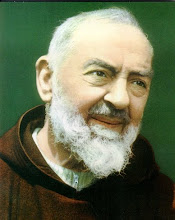
Yet, even as we are attracted to this radical love of God, we are often frightened by it. Is it surprising that, in the face of the holiness and extraordinariness of Padre Pio, my mother declared that he made her feel scared, because she could never be that holy? Is it any wonder that a forum friend of mine did not wish to read about Mother Teresa, because then she might feel obliged to make such a great sacrifice…and she did not think she could handle that? Sometimes, we stand in awe and admiration of the Radical Love and lives of the saints. At other times, we run away; not unlike Jonah. Often, it moves us to despair that we will ever be “so holy,” and we feel this way whether we gave up at the mere thought of being radical, or put forth a good effort and still failed to begin a Mother Teresa-like movement.

If you guessed that this is not a good thing, congratulations. You have a brain. While it is only fitting to admire complete, total, radical self-gift, we must not fall into a very common mistake.
We must not confuse radical with big, or vice versa.
We all too often do this, and in the face of obvious radicalness, we come to see small, everyday acts as lesser. Would Saint Gianna Molla mean as much to us if she had not died (despite the fact that her choice for Life was technically completely unrelated to her cause of death, anyway)? Probably not. Her death adds drama her story, the apparent radicalness we Catholics like. A surgery—no matter how risky—is not quite as interesting as dying. Thus we hear more about her death than we do about her life (which, in my opinion, was rather more a testament to her faith and charity). We look at Mother Teresa, all the people she touched and the movement she began, and Saint Therese of the Little Flower seems to pale in comparison.

I think that we need to remind ourselves that it is not the drama which made the saints great. It was their love shown in the little things. Even Mother Teresa’s life was not big. We see her actions as one unified whole, something big and grand. Yet this is not so. We only see it this way because we are on the outside looking in. To Mother Teresa, every poor person, every hug, every look, every word was individual. It was a small everyday thing. Small things just piled up to a point where they looked like something big. Her life was one, long, Little Way. She is no different from Saint Therese. She realized what we so often forget:
There are no great things. There are simply bunches of small things. There are only repetitive, every day, ordinary things done with repetitive, every day, extraordinary love.

I think we should remember this next time the fire we have to go out and “convert all the peoples” dies down and we find that we have seemingly done nothing big. I think we should remember this when we cower before the greatness of Padre Pio and despair that we will ever be that holy. I know I need to remember:
When we make all the little things radical, only then can we really live our faith radically. Only by bringing the little, everyday things in our lives to God can we bring our entire lives to Him.

Subscribe to:
Posts (Atom)