Showing posts with label The Purpose of Pain. Show all posts

Friday, February 10, 2012

The Third Purpose of Pain

When I was very small—only about eight or nine—my mother and I stopped to eat lunch at a McDonald’s. I remember the day very well; we sat outside at one of the red tables, mom eating her burger and me my chicken nuggets. Across from us was a little girl with her mother. She was just my age and was enjoying the same meal as I. However, unlike me, she did not possess the same amount of fingers as most human beings. She only had four fingers between two hands, and if ten chicken nuggets weren’t enough of a challenge, a container of barbecue sauce was thrown into the mix. I tried not to stare, I really did, but I could not keep myself from watching as she struggled to eat. Picking up one piece of meat, maneuvering it carefully to dip it into the sauce…the process was painfully slow. Her mother’s face was very sad as she watched her daughter strive and fail at what I myself was doing so easily across the way (or maybe she was sad because I was staring…). However, it is the little girl’s face which I will never forget. She was so cheerful. “Oops! I dropped my chicken nugget!” she laughed once, undaunted by the simple yet oh-so-complicated task before her. A pianist, I couldn’t imagine lacking even one of my fingers, much less six, but she was so composed, taking it all in stride.

I did not say one word to her. I do not know her name. But to this day, when I think of perseverance, I see that girl’s face. This is not an isolated experience, and I do not think it is just I who has moments such as these. Often do we learn things from the trials and sufferings of others. It is, after all, the third purpose of pain:


-To teach to others, through our own example, virtues and other lessons which
will help them become better people.

While the first purpose is obvious, and the second acceptable, not very many people recognize this third purpose and fewer still learn to appreciate it. In a materialistic and essentially selfish world, is it really to be wondered at? No one thinks of other people when they themselves are suffering, and many people are so horrified at the thought of suffering that they can only pity those whom they should be learning from (I plead guilty to this). But this third purpose of pain is the most important, for the very same reason most fail to see it:


It extends beyond the self.


It isn’t about us; the picture is much bigger than that. It is about the rest of the world. I saw that girl for all of ten minutes, and never saw her again. She will never know that I remember her; I doubt she remembers me. But she taught my little self something that day that will be with me and help me for the rest of my life. Who knows how many people you can touch, and have touched, by “suffering well” (as St. Therese puts it)? Not a single person may have ever said a word to you about it, but you could have touched more people than there are stars. It’s like those Liberty Mutual commercials… What could be less pointless?

And what if no one sees, you ask? (This is one of my favorite things about being Catholic) All is not lost. Jesus suffered. He was beaten with the most brutal torture devices, nailed to a cross, and left to suffocate to death. God Himself suffered and died. Jesus redeemed suffering and made it redemptive. Not only does this mean that suffering in itself cannot be evil (because God assented to it and did it Himself) but it means that everyone who suffers reflects Christ. Every time we suffer, we are united with Christ on the Cross, and His mission to save souls becomes our mission. This isn’t only accomplished when someone sees and takes our example. It occurs in the silence of our hearts and homes, locked in the deepest corners of our rooms and minds. We can help others—without their even knowing it—by uniting ourselves with the Crucified Christ and earning graces for them. We can suffer for the sake of living people, the conversion of sinners, the souls in Purgatory… United with Christ on the Cross, we assist in His redeeming mission. Even if no one sees it.


“Now I rejoice in my sufferings for you, and fill up those things that are
wanting of the sufferings of Christ, in my flesh, for his body, which is the
church.” –Colossians, 1:24

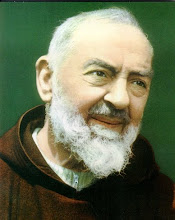
Next time I feel burdened by trials, my pain becomes unbearable, and I feel that God cannot be the all-good and all-loving God we believe Him to be, I’m going to grab this picture and look Him in the eye…


…and remind myself that no suffering is a pointless evil.


What are you going to do?

Monday, February 6, 2012

The Second Purpose of Pain

The first purpose of pain is fairly easy to see, in hindsight. The direct correlation between action and consequence is often difficult to deny, as with contraceptives and breast cancer. However, sometimes there is no discernible self-originating cause for suffering. Surely the child with bone cancer, the victims of the earthquake in Haiti, and those who are infertile yet want children did not create their own crosses. Some people call this type of suffering a "pointless evil." Where is the design of an all good and all loving God in this? The answer is not simple, but it is understandable.

-The second purpose of pain is to provide us with the opportunity to fully develop virtues we would have otherwise never learned.

Imagine if your parents never asked anything distasteful of you. You would have never gone to school, never learned to read or write. You would have never given your sibling that much-dreaded kiss, never made up with them... Your life would probably be miserable. Think about what sort of household you would have if you didn't give your children chores. They would not know how to keep their room clean, wash the dishes, or wash their clothes. They wouldn't be able to keep alive a pet or manage keeping a job when they grow up.

They probably wouldn't get very far.

Our parents didn't ask distasteful things of us only because we deserved it, and we don't give our children chores only when they have done something wrong. Often, things we see as unpleasant, bad, and "evil" are not dished out because we have acted wrongly, but because something good was expected of and given to us. We had to go through the unpleasantness to get it. Virtues are gained through suffering. One cannot learn patience if they have never had to wait for anything. One cannot perfect humility if they have never been humiliated. Oftentimes, we undergo the most despised situations only to come out better people on the other side.

One person could attest to this second purpose of pain very well. Her name is Saint Thérèse of Lisieux. Thérèse was born on January 2, 1873 and became a Carmelite nun at the age of fifteen. After living a quiet and holy life, she died of tuberculosis at the age of twenty-four, on September 30, 1897. A few simple sentences illustrate how she realized the second purpose of pain working in her soul.


"I have noticed that the experience of suffering makes us kind and indulgent
toward others because it is suffering that draws us near to God... Trials help
us detach ourselves from the earth; they make us look higher than this
world."


Her suffering showed her how fragile life is and brought her to greater awareness of her relationship with God and the goal of heaven. It taught her charity. What can we learn from our own suffering? Patience? Humility, fortitude, or chastity? Love of others? Love of God? Every "pointless evil" has something to teach us, to offer us in the way of becoming better people. It can replace Purgatory, purifying our souls, perfecting our hearts, and readying us to see Our Creator face to face.

Next time we find ourselves in a "pointless evil," we should see it as an opportunity. We should try--like Thérèse--to see the hand of a loving parent, kindly yet firmly teaching us what we will need to know in order to flourish in this life and the next. We may come to realize that it's not really an evil at all.


"I suffer much but do I suffer well? That is the important thing." -St. Thérèse
of Lisieux


TO BE CONTINUED

Thursday, January 26, 2012

The Purpose of Pain

"Does God really care about us? If so, why does He permit suffering?"

The question was written in bold letters across the front of the Watchtower magazine our friendly neighborhood witness for Jehovah had just handed me. And while I found the answer in the pamphlet to be less than satisfactory, I realized the importance of the question. Had I not asked it many times, for myself and my loved ones? "God, if you love me, why did You create me deformed? God, if You love him, why did You let my grandfather get cancer? How could You let my brother and sister die so young? How can You let these bad things happen?" They are questions I have heard from others many times, especially from atheists. In a world so full of pain, it is hard to see a merciful and loving God. It is too easy to, like Personal Failure, come to the conclusion that God--if He exists at all--must be very cold and cruel. And thus the question echoes on in an aching universe: If God is truly loving, how can He let bad things happen? In answer, I propose that pain has a purpose. In fact, I maintain that it has three.

-The first purpose is to teach us about responsibility.

Now, two types of people like to balk at this. The first says that we can't possibly do anything to merit suffering because God--being God--allowed it in the first place, and even made us do it. "You can’t give God the credit for the good without also blaming Him for the bad," sums this mentality up rather well. This is answered rather simply, from a Christian viewpoint. We maintain that God is Love and Goodness in itself. Naturally, if we do anything Loving and Good we are doing it with Him and are capable of it because of Him. This is much like crediting solar power and photosynthesis to the sun; it wouldn't have been possible without the sun. However, to say that we can blame God for the bad is a lot like saying we can blame the sun for darkness and the necessity of flashlights. Evil does not come from God. It is not even a thing unto itself. Rather, it is a lack of God, just like darkness is a lack of light. When people do bad things, they move farther away from God, Love, and Goodness. When people do bad things, those things are bad precisely because God is *not* involved. We cannot blame God for our moving away from Him.
The second type of person thinks that if God really loved us He would save us from pain no matter how much we deserved it. Though the comparison has been used many times before, I have to recycle it here: that's just like a whiny little kid. "If you really cared for me, you'd just forgive me for getting an F on my biology test and let me go to Kirsten's party!" Which note dumps us right back into the first purpose of pain: responsibility.

Responsibility is a crucial point of development in the life of a child. It is the ability to perceive the relationship between action and consequence and to handle the repercussions of one's choices accordingly. We are not born with this knowledge: it is taught to us at a very early age through experience and by our parents. When we crossed the road without first looking (assuming we weren't crushed by a car) our parents fussed us. When we failed a test for lack of study, our parents grounded us. We were told not give our information out of the Internet and, if we did so anyway, our parents punished us for it. All to teach us that when we do things, there are consequences, and when we do bad things there are unpleasant consequences. Our understanding of this deepens as we grow older and become more mature until we learn to not do bad things in the first place. If we could not learn to face the repercussions of our actions or prevent them by not acting, we would never grow...and we might very well end up suffering twofold for our ignorance. This applies in the spiritual realm as well as the physical.

We are fallen men. We can choose to move away from God, and often do. When we do this--when we commit sin--we will face negative repercussions. If we view porn, our relationships suffer. If we use birth control, our relationships suffer...and we can suffer infertility problems. Every bad action has a negative consequence, and it is by facing these consequences that we learn--wonder of wonders--not to do bad things! Like a parent grounding their children for failing a test or giving their information out on the Internet or fussing their child for crossing the street without first looking, God allows us to suffer for our actions, to meet the natural and direct consequences of the choices we willingly made. To teach--that is the first, most obvious, and most mundane purpose of pain.

TO BE CONTINUED: HERE