Showing posts with label The Little Things. Show all posts

Friday, March 29, 2013

United with Christ

When we unite ourselves with Christ on the Cross, our tears become jewels with which we can decorate our mansions or pay the debts of others.
Otherwise, they are just tears.

Wednesday, January 23, 2013

Living Radically

We Catholics adore the radical. We thrive on extreme examples of faith; on stories of saints who were crucified, roasted alive, caught deadly diseases in the line of priestly duty; on tales of saints who floated and bi-located, had mystical visions, foretold the future, and ordered around kings and Popes. This should not be cause for astonishment. When you love someone, you want to serve them radically. When you love something, you want to throw yourself heart and soul into it until there is either nothing left to throw, or nothing left to throw at. And I would certainly hope that we Catholics love Christ and our Faith!

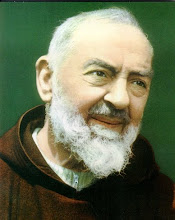
Yet, even as we are attracted to this radical love of God, we are often frightened by it. Is it surprising that, in the face of the holiness and extraordinariness of Padre Pio, my mother declared that he made her feel scared, because she could never be that holy? Is it any wonder that a forum friend of mine did not wish to read about Mother Teresa, because then she might feel obliged to make such a great sacrifice…and she did not think she could handle that? Sometimes, we stand in awe and admiration of the Radical Love and lives of the saints. At other times, we run away; not unlike Jonah. Often, it moves us to despair that we will ever be “so holy,” and we feel this way whether we gave up at the mere thought of being radical, or put forth a good effort and still failed to begin a Mother Teresa-like movement.


If you guessed that this is not a good thing, congratulations. You have a brain. While it is only fitting to admire complete, total, radical self-gift, we must not fall into a very common mistake.

We must not confuse radical with big, or vice versa.

We all too often do this, and in the face of obvious radicalness, we come to see small, everyday acts as lesser. Would Saint Gianna Molla mean as much to us if she had not died (despite the fact that her choice for Life was technically completely unrelated to her cause of death, anyway)? Probably not. Her death adds drama her story, the apparent radicalness we Catholics like. A surgery—no matter how risky—is not quite as interesting as dying. Thus we hear more about her death than we do about her life (which, in my opinion, was rather more a testament to her faith and charity). We look at Mother Teresa, all the people she touched and the movement she began, and Saint Therese of the Little Flower seems to pale in comparison.


I think that we need to remind ourselves that it is not the drama which made the saints great. It was their love shown in the little things. Even Mother Teresa’s life was not big. We see her actions as one unified whole, something big and grand. Yet this is not so. We only see it this way because we are on the outside looking in. To Mother Teresa, every poor person, every hug, every look, every word was individual. It was a small everyday thing. Small things just piled up to a point where they looked like something big. Her life was one, long, Little Way. She is no different from Saint Therese. She realized what we so often forget:

There are no great things. There are simply bunches of small things. There are only repetitive, every day, ordinary things done with repetitive, every day, extraordinary love.

I think we should remember this next time the fire we have to go out and “convert all the peoples” dies down and we find that we have seemingly done nothing big. I think we should remember this when we cower before the greatness of Padre Pio and despair that we will ever be that holy. I know I need to remember:

When we make all the little things radical, only then can we really live our faith radically. Only by bringing the little, everyday things in our lives to God can we bring our entire lives to Him.


Radical is Small.

Missionaries of Charity

The Missionaries of Charity
What does the name even mean? A missionary is someone who brings God to those who do not have him. Long ago missionaries came to evangelize those living in both North and South America. They risked their lives (and very often lost them) to bring God to those people. Charity is also called love. So the missionaries of charity are, by their name, people who bring God to others through love. Mother Teresa once said that all are called to be missionaries of charity, and I am inclined to agree.
All people have a vocation. We are all here for a purpose which God has given to us. When we find it we must give everything we are to fulfill this vocation. This complete gift of self is love, and therefore a vocation is in and of itself love. Because of this we all have the base vocation to love. If we work at it and become a loving person, we will desire to spread this love of God to others. We will not be able to keep it to ourselves and therefore we must spread love of God to every person we can. So by finding our vocation and becoming a loving person, we will become a “missionary of charity” by necessity. No matter our vocation, whether it be priesthood, religious life, married life, or single life, we are all called to be missionaries of Charity, to bring God into the world through His love. We are called to be, “missionaries of charity.”

Friday, November 16, 2012

Music is the Language of Heaven


I have heard this saying before by many, many people. A casual Google search did not reveal to me who first said it, but I like the quote just the same. It is very easy to see--or rather, hear--why music would be the language of heaven. It has some magnetic attraction to it; there is not a single culture in the history of the entire world that did not have music as a part of its fabric. There is also something otherworldly about it; it has the power to move us, lift us, bring us to our knees or to our feet. Yes, there is something great and grand about music that makes it a fitting tongue for the angels. I think that music touches our soul because it reveals to us who and what we are supposed to be; it speaks to us of an eschatological reality. That is, the communion of saints.

(Commence random, rambling reflection)

We all struggle with finding the meaning of difference, with balancing our desire to be accepted, to have a place and a purpose, with our desire to be recognized as individuals with individual value. Some of us, in our struggle to be accepted, deny that there is any difference between us. We are all the same, with the same purpose and meaning. The remainder of us are so focused on the fact that we are ourselves, that we are individuals, that we deny there is any purpose or place for us in the larger scheme of humanity. Balance so easily escapes us, yet we long for it. We long for it because we were made in the image of Communion, the image of the Trinity. Our nature reflects that of an indivisible whole with distinct parts: One God and Three Persons. We humans are just such an organism; distinct, but not separate; together, but not un-individual.

Music captures this aspect of our humanity better than anything else I can think of. Each note is distinct; no one would ever argue that they are the same. Yet, they are equal, and all play a part in the composition. The highest, softest C makes the song just as much as the lowest staccato G#. The beginning of a sonata is no less or more important than the end. By themselves each note is equal and pretty, certainly. But together…they make something beyond beautiful. And the composition would not be the same if a single one were missing. In losing themselves in the entirety of the composition, they find their own individual, distinct beauty.

We are each music notes in the communion of saints. Each pretty, each distinct, and altogether ineffably magnificent. Music captures the essence of communion; the essence of human nature. Music is what we are. Music is the language of humanity.

(Now, listen to THIS)

Thursday, May 31, 2012

God: Only In Hospitals

(Warning: coffee- and sleep- deprived post; read at your own risk!)

Our parish has a door to door evangelization team to rival that of the local Jehovah’s Witnesses!  Okay, no, we don’t.  I’m just kidding.  Our team is much smaller, only goes out once a month, and is much, much less annoying.  They just go out in teams of three to different neighborhoods.  One person does the talking, the second team member writes prayer requests down, and the last prays for both the team and the people they are visiting.  At each house, a simple question is asked:

“How can we help you?”


 I’ve been out with the Evangelization Teams only once.  That time, I misunderstood the schedule and arrived at the church hall a day early for a discernment talk, only to find myself caught up in an E.T. meeting.  On a spur-of-the-moment decision, I figured I would go out with them that day, and I did.  After being paired with two older women and taking up the position of Pray-er, we drove to a neighborhood of about twenty houses and began knocking.  The majority of the houses we visited were empty, their occupants out a-visiting themselves on that rainy Saturday.  Nevertheless, a few persons came to the door, and were asked our question.

“How can we help you?”


 We never specified what sort of help.  We’d do anything for them, spiritual or menial.  Change a lightbulb, fix a Rosary (it was a beautiful Job’s tears Rosary), get Father to bring them communion, etc.  However, the majority of people understood us as asking if they needed prayers.  Their responses generally ran like this:

“Nope, I’m good.  The family’s good.  No one’s sick.”


Or

“Well, there is this girl that lives over-the-way and she has leukemia.  Can you pray for her?”


 Now, as nice as it is to hear of other’s care for the sick, and as cheering as it is to know that a family is in good health, I noticed a trend in these answers that soon unsettled me, not least of all because I recognized them in myself.  Why is it that we only ask for prayers when we are in trouble, especially illness or other things too large for us to handle on our own?


I’m not certain why I do this.  If I am brutally honest, it is probably because I am too independent.  I harbor the mindset that I can handle things; I’m strong, and smart, and completely capable of taking care of myself.  Besides, God helps those who help themselves, right?


Wrong.  Not only is that verse not in the Bible, it is completely inaccurate.  God wants us to come to Him like little children.  And what do little children do but come openly, with humility, for *all* of their needs?  Not just the big ones, but *all* of them.  A toddler turns to her father to have her teeth brushed.  An infant turns to his mother for *everything*.  Children are not independent; they are needy, with an expectant, trusting sort of need.   God wants us to come to Him like that. 


Perhaps our hesitation to come to God with anything but big troubles is because we think we have nothing else to tell Him.  What is my joy over a new job compared to that girl-over-the-way with leukemia?  What is my joy over my puppy compared to the loss of that child whose mother overdosed?  Okay, God wants the small things.  But surely He doesn’t want happy things.  He has more grave concerns, more troubled people to help, than my quite contented self!  This is an understandable mindset, from our own point of view.  I mean, if you had a choice between listening to someone squeal over a bunny, or helping a person in a car accident, which would you choose?  However, I think this mindset, this perspective, misunderstands the nature of God. 


God doesn’t need to choose.  To say that God cannot pay attention to “this” because He is busy doing “that” is to forget that God is omnipotent and omnipresent.  He has more than enough mental capacity and attention span to listen to *everything* anyone could ever bring Him.  God can never be too busy for each of us individuals.  Furthermore, and to put it all in another light: if you only went to your friend when you needed something big from them, would you consider yourself as having a good relationship with them?  I wouldn’t, and the fact that I do this with God reflects pretty heavily on the sort of relationship I have with Him, I think.


We act as though God is available for a limited amount of time, and we save that time for Bad Things.  We think as if we believed that God is a last resort, only to be called when we can no longer handle the situation.  We pray as if God is only interested in our troubles.


I call this the “God Is Only in Hospitals” mentality, and I am very guilty of it.  So, today I pray for the grace to always remember that the small things are never too small for God, and that He does not want just my sufferings, sorrow, and trials, but my pleasures, joy, and peace.

Saturday, May 12, 2012

Of Canyons and People

(Warning: unedited, coffee- and sleep- deprived post.  Read at your own risk.)
Recently, I found myself here^, gazing upon one of the seven wonders of the world: the Grand Canyon.  As I sat with my godchild, our legs dangling off the edge of a cliff, I looked out upon the gargantuan crater to the semi-circled mountains beyond.  The land of my birth not being condusive to far-sight (too many trees upon too-flat ground), I had never seen so far in my life.  I could see for miles, until distance overcame the clear air and the background faded into a smoky haze of grey.  Beneath our feet, between us and the Canyon floor, were large, flat, plain-like rocks that would have made a perfect stage for a rock concert.  The acoustics would have been grand.


In the distance I saw the river, the white water of the rapids noticeable even from my height:
But the water which I knew must have been swirling in a volitile rage miles away looked as still as this picture; for all its motion, it never moved.  In fact, the Canyon as a whole was as silent and motionless as these photographs (though much more impressive, of course).  I asked a fussy godchild what she thought lived down in the Canyon.
"Mountains," was the sniffled answer.
"True!  But what else?"
"More mountains...and rocks..."
Indeed.  All there was were rocks, rocks, and more rocks.  The monotnoy of the place was smothering, even as the size and open spaces were liberating.  I could not help but think that I was looking upon a thing that had been there eons before I knew existence, and would be there long after I am gone.  I was looking upon a thing that never changed, or knew things that changed, or cared. So...

I sat and held my godchild in my arms and thanked God that humans are fleeting.  Every one of the tourists (many from foreign countries, speaking in a babble of languages I did not understand) had come to see a marvel that for years has stolen the breath of the world.  And yet each of them, with their miniscule lives, were ineffably more precious.  Unlike the semi-circular plateaus, they were unrepeatable.  Unlike the Canyon, they would only be here once and for a very short time.  The Canyon was a marvel.  It was beautiful.  It was awe-inspiring.  It made me think of eternity.  But, mostly, it made me think of how much more of a marvel are the people around me--so small in comparison, but far more alive, far more unique, far more wondrous.  The Canyon would be there to inspire and impact millions for generations to come.  But that person I see on the street?  My elderly grandfather?  That child in the store?  They won't be.  I went to the Canyon seeking wonder, as do most.  I left thinking that it had been around me all the time, I was just never good at noticing it.