Sunday, December 30, 2012

Teach the Lesson You Want Learned

When I heard about the shooting in Connecticut, and about the shooter, I thought, “That young man is a genius, and he learned well.”

For the past year, we have screamed, “Birth control! Birth control!” as though preventing the existence of children is the single most important concern of our lives. Oh, the assertion that contraceptives must be had or else women will be completely and utterly useless has been around for quite some time—about eighty years now. However, people have been particularly vocal about it recently. It does not matter why the discussion began anew or who began it. The assertion is clearly there, and it always has been: that preventing the existence of children is a wonderful thing and we are proud to be able to do it.

For the past fifty years, we have been saying that if we fail to prevent the existence of new human life, we should kill it; with certain restrictions, of course—the main one being that we can only do it if we have no sense of emotional attachment to aforementioned human life. We go so far as to call an unborn child a child when we want it and a “blob of tissue” when we don’t.

And if these new human individuals, these blobs of cells, happen to defy this attempt to make certain they are never born, we give them comfort rooms. We are proud of the fact that we helped them die among blankets and flowers, and conveniently ignore the fact that we did nothing to help them live. Some say that this doesn’t happen and no one wants that. Yet I have had long discussions with more than one individual who said that we should not put forth any effort to save infants who have survived abortions, even if they are viable. “Imagine the emotional trauma that would put a woman through, knowing that she wanted an abortion and it failed and the child is out there living in the world!” one woman said. Another man stated that it would be “too expensive” to try to save the infants “no one wants anyway”.

We told this mother that she should have killed her son before he was born, simply because he was born blind. We tell something similar to mothers whose children have Down Syndrome, and boast of the fact that about 80-95% of human individuals with Down Syndrome never see the light of day. I guess caring for them would be “too expensive”.


When we saw that two disabled adults had been in homes since they were ten, when we heard their mother say that they had no joy, we did not have the bright idea of trying to bring them some joy. Instead, 90% of us cried, “Yes! Kill them!” Many of us are advocating that we make it happen, legally and frequently. Why keep a human individual alive through “extraordinary measures” when it is cheaper to let them starve? Why put forth effort to bring them joy when we can prevent their suffering by killing them?

We are good at finding reasons not to want human individuals. We are equally good at doing mental gymnastics to prove that these reasons justify getting rid of these human individuals, or that they make it impossible for such human individuals to, in fact, be human individuals.

For a good half-century and longer, we have done just about everything in our power to prove—in word and deed—that we do not value the lives of human individuals…unless we happen to want them. And then we have the audacity to act surprised and horrified when one of our children comes along and actually puts that philosophy into practice.

That young man was a genius, and he learned well. He learned the lesson that we as a society have been preaching for so very long, and we are hypocrites if we condemn him for it. We are hypocrites and idiots if we tell a young man with a disorder that inhibits him from connecting to other human beings that it is wrong to kill them, and then turn around and argue we can kill other human beings because it is impossible to establish a connection with them*.

From Here


People are looking at the tragedy that occurred at Sandy Hook, and asking, “How could this happen? Why did this happen?” Some assert that it is the fault of guns. Others postulate that it happened because of violent video games. Still others accuse mental illness. I say that it is our fault. Your fault. My fault.

We did it.

It happened because we teach our children that the lives of human individuals do not matter and have no value, and we have proven via our actions that we stand by this belief.

It happened because we made it happen. Because we taught that it should.

And the only way to prevent it from happening again, is to change. Change the way we think about our fellow human beings. Begin valuing lives; not just the ones we naturally are inclined to want, but every human life. Every single one. Everywhere.

That young man was a genius, and he learned well. We have a great power to teach. Now, let’s change the lesson.


*I am NOT saying that those with Asberger's are naturally violent, or that it was autism that caused the shooter to do what he did. I am merely pointing out that he validly had the same excuse we use to defend ourselves: lack of empathy with those human individuals we want to kill.

Friday, November 16, 2012

Music is the Language of Heaven


I have heard this saying before by many, many people. A casual Google search did not reveal to me who first said it, but I like the quote just the same. It is very easy to see--or rather, hear--why music would be the language of heaven. It has some magnetic attraction to it; there is not a single culture in the history of the entire world that did not have music as a part of its fabric. There is also something otherworldly about it; it has the power to move us, lift us, bring us to our knees or to our feet. Yes, there is something great and grand about music that makes it a fitting tongue for the angels. I think that music touches our soul because it reveals to us who and what we are supposed to be; it speaks to us of an eschatological reality. That is, the communion of saints.

(Commence random, rambling reflection)

We all struggle with finding the meaning of difference, with balancing our desire to be accepted, to have a place and a purpose, with our desire to be recognized as individuals with individual value. Some of us, in our struggle to be accepted, deny that there is any difference between us. We are all the same, with the same purpose and meaning. The remainder of us are so focused on the fact that we are ourselves, that we are individuals, that we deny there is any purpose or place for us in the larger scheme of humanity. Balance so easily escapes us, yet we long for it. We long for it because we were made in the image of Communion, the image of the Trinity. Our nature reflects that of an indivisible whole with distinct parts: One God and Three Persons. We humans are just such an organism; distinct, but not separate; together, but not un-individual.

Music captures this aspect of our humanity better than anything else I can think of. Each note is distinct; no one would ever argue that they are the same. Yet, they are equal, and all play a part in the composition. The highest, softest C makes the song just as much as the lowest staccato G#. The beginning of a sonata is no less or more important than the end. By themselves each note is equal and pretty, certainly. But together…they make something beyond beautiful. And the composition would not be the same if a single one were missing. In losing themselves in the entirety of the composition, they find their own individual, distinct beauty.

We are each music notes in the communion of saints. Each pretty, each distinct, and altogether ineffably magnificent. Music captures the essence of communion; the essence of human nature. Music is what we are. Music is the language of humanity.

(Now, listen to THIS)

Sunday, October 21, 2012

Reflection on the Imitation of the Sacred Heart of Jesus

“Learn of Me because I am meek and humble of heart’ and ye shall find rest for your souls.” We should Learn of Jesus. We should imitate him because by doing so we can hope to attain eternal life with God. By doing so we shall pass the perishable wealth of this finite world and inherit the eternal wealth of God, our infinite creator. All that Jesus taught is contained in this lesson, of learning of Him and imitating him, as he practiced his teachings before he taught them. This lesson is all we need and the first step towards learning it is prayer. We must then see what we must fix in our lives so that we will be imitating Jesus. Finally we must practice what we have learnt. To do so we must become “meek and humble of heart” in what we both say and do.
If we learn the lesson then we sill receive the promised reward, rest for our souls. We will be resting in God, He who has created us for this very purpose. He loves us so much that he wants to share himself entirely with us.
As we gain this rest we will be making our way towards our end, eternal union with God. This end that we are destined and made for is the reason that people are always searching for something to complete themselves. Unfortunately these people often look on earth for these things. Even more unfortunate is the fact that people often look for these things in sin which has the appearance of happiness but will in the end cause only pain. Nothing of this world will last, and nothing of this world will give us the unceasing happiness that we so desire. The only person who can provide us with the eternal rest and happiness which we desire is God. So in this light can there be any more honorable and worthwhile task for us to do than to imitate the Sacred Heart of Jesus? ~Jacen Marx

Thursday, October 4, 2012

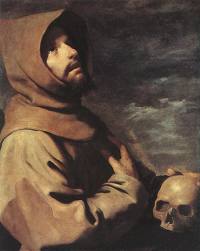
A Prayer to Saint Francis

Father Francis, you were known during your life on this earth for your Joy. Even now, long after your exile here has ended, you are still known for your Joy. You are the saint who befriended all of the birds, and tamed the wolves. You are the saint who preached on the street corners to anyone and everyone. You are the one who kissed a leper.
We know and admire you for your constant happiness...yet we also know you for your suffering. You embraced Lady Poverty with a will and exuberance that I can hardly imagine. You owned nothing, not even your next meal. You suffered through many long and difficult journeys, through the desert and across the borders of nations. You struggled with scorn and ridicule and disrespect both from within and from without your own Order. And you bore the Stigmata.
In my world, Father Francis, joy and suffering--joy in suffering--is rarely heard of. We lose ourselves in a million mundane, meaningless, and even harmful things, drowning joy in happiness, and mistaking the latter for the former. We are too afraid to face the pain that must be gone through to attain true joy: the pain of self-denial, self-giving, selflessness. Little Father, please teach us your secret. Please teach us how to find joy in suffering, and through suffering, joy.

Monday, October 1, 2012

Little Playthings

"I had offered myself...to the Child Jesus as His little plaything.  I told Him not to use me as a valuable toy children are content to look at but dare not touch, but to use me like a little ball of no value which He could throw on the ground, push with His foot, pierce, leave in a corner, or press to His Heart if it pleased Him." 


Well, as you can see, I am still here.
Writing, not entering.
A student insread of a postulant.

Others are beginning to notice.  Just today one of my former students came to me and asked, "Aren't you gong to be a nun?"

The honest answer is, conventiently enough, also the shortest:  I don't know. 
Quite a while ago God told me to wait...and wait...and wait...  Now, it seems as though I am not just waiting to know what to do about my future and my vocation, but as though my entire life is on hold.  This quote from Saint Therese has always been one of my favorites from her, and it has been much on my mind lately.  It really feels as though God has "left me in a corner". 

Saint Therese, please help me to truthfully make your request my own.  I want to offer myself--my entire will--to Jesus, for Him to do with me as He pleases.  I want to Love whatever circumstances or position He sees fit to place me in, and not merely resign myself to His Will.  However, this takes a humility and patience which I just do not have, and it is so very hard.  Please teach me your childlike trust, your simple Love of Jesus and lack of self, so that I, too, may happily be His little "plaything".


Friday, September 28, 2012

The Vindication of Humanae Vitae

by Mary Eberstadt

"Perhaps the most mocked of Humanae Vitae’s predictions was its claim that separating sex from procreation would deform relations between the sexes and “open wide the way for marital infidelity and a general lowering of moral standards.” Today, when advertisements for sex scream from every billboard and webpage, and every teen idol is sooner or later revealed topless or worse online, some might wonder what further proof could possibly be offered.

But to leave matters there would be to miss something important. The critical point is, one might say, not so much the proof as the pudding it’s in. And it would be hard to get more ironic than having these particular predictions of Humanae Vitaevindicated by perhaps the most unlikely—to say nothing of unwilling—witness of all: modern feminism.

Yet that is exactly what has happened since 1968. From Betty Friedan and Gloria Steinem to Andrea Dworkin and Germaine Greer on up through Susan Faludi and Naomi Wolf, feminist literature has been a remarkably consistent and uninterrupted cacophony of grievance, recrimination, and sexual discontent. In that forty-year record, we find, as nowhere else, personal testimony of what the sexual revolution has done to womankind.

Consider just what we have been told by the endless books on the topic over the years. If feminists married and had children, they lamented it. If they failed to marry or have children, they lamented that, too. If they worked outside the home and also tended their children, they complained about how hard that was. If they worked outside the home and didn’t tend their children, they excoriated anyone who thought they should. And running through all this literature is a more or less constant invective about the unreliability and disrespect of men.

The signature metaphors of feminism say everything we need to know about how happy liberation has been making these women: the suburban home as concentration camp, men as rapists, children as intolerable burdens, fetuses as parasites, and so on. These are the sounds of liberation? Even the vaunted right to abortion, both claimed and exercised at extraordinary rates, did not seem to mitigate the misery of millions of these women after the sexual revolution.

Coming full circle, feminist and Vanity Fair contributor Leslie Bennetts recently published a book urging women to protect themselves financially and otherwise from dependence on men, including from men deserting them later in life. Mothers cannot afford to stay home with their children, she argues, because they cannot trust their men not to leave them. (One of her subjects calls desertion and divorce “the slaughter of the lambs.”) Like-minded feminist Linda Hirschman penned a ferocious and widely read manifesto in 2005 urging, among other bitter “solutions,” that women protect themselves by adopting—in effect—a voluntary one-child policy. (She argued that a second child often necessitates a move to the suburbs, which puts the office and work-friendly conveniences further away).

Beneath all the pathos, the subtext remains the same: Woman’s chief adversary is Unreliable Man, who does not understand her sexual and romantic needs and who walks off time and again at the first sashay of a younger thing. What are all these but the generic cries of a woman who thinks that men are “disregarding her physical and emotional equilibrium” and “no longer considering her as his partner whom he should surround with care and affection”?

Perhaps the most compelling case made for traditional marriage lately was not on the cover of, say, Catholic World Report but in the devoutly secular Atlantic. The 2008 article “Marry Him!” by Lori Gottlieb—a single mother who conceived her only child with donor sperm rather than miss out on motherhood as she has on marriage—is a frank and excruciatingly personal look into some of the sexual revolution’s lonelier venues, including the creation of children by anonymous or absent sperm donors, the utter corrosiveness of taking a consumerist approach to romance, and the miserable effects of advancing age on one’s sexual marketability.

Gottlieb writes as one who played by all the feminist rules, only to realize too late that she’d been had. Beneath the zippy language, the article runs on an engine of mourning. Admitting how much she covets the husbands of her friends, if only for the wistful relief of having someone else help with the childcare, Gottlieb advises: “Those of us who choose not to settle in hopes of finding a soul mate later are almost like teenagers who believe they’re invulnerable to dying in a drunk-driving accident. We lose sight of our mortality. We forget that we, too, will age and become less alluring. And even if some men do find us engaging, and they’re ready to have a family, they’ll likely decide to marry someone younger with whom they can have their own biological children. Which is all the more reason to settle before settling is no longer an option.”

To these and other examples of how feminist-minded writers have become inadvertent witnesses for the prosecution of the sexual revolution, we might add recent public reflection on the Pill’s bastard child, ubiquitous pornography.

“The onslaught of porn,” one social observer wrote, “is responsible for deadening male libido in relation to real women, and leading men to see fewer and fewer women as ‘porn-worthy.’” Further, “sexual appetite has become like the relationship between agribusiness, processed foods, supersize portions, and obesity. . . . If your appetite is stimulated and fed by poor-quality material, it takes more junk to fill you up. People are not closer because of porn but further apart; people are not more turned on in their daily lives but less so.” And perhaps most shocking of all, this—which with just a little tweaking could easily have appeared inHumanae Vitae itself: “The power and charge of sex are maintained when there is some sacredness to it, when it is not on tap all the time.”

This was not some religious antiquarian. It was Naomi Wolf—Third Wave feminist and author of such works as The Beauty Myth and Promiscuities, which are apparently dedicated to proving that women can tomcat, too. Yet she is now just one of many out there giving testimony, unconscious though it may be, to some of the funny things that happened after the Pill freed everybody from sexual slavery once and for all.

That there is no auxiliary literature of grievance for men—who, for the most part, just don’t seem to feel they have as much to grieve about in this new world order—is something else that Humanae Vitae and a few other retrograde types saw coming in the wake of the revolution. As the saying goes, and as many people did not stop to ask at the time, cui bono? Forty years later, the evidence is in. As Archbishop Charles J. Chaput of Denver observed on Humanae Vitae’s thirtieth anniversary in 1998, “Contraception has released males—to a historically unprecedented degree—from responsibility for their sexual aggression.” Will any feminist who by 2008 disagrees with that statement please stand up?"

If you have not read the entire article, you must do so HERE 

Wednesday, September 26, 2012

Meaningless and Repetitious Prayer

Jesus tells us in Matthew 6:7 “When you are praying do not use meaningless repetition as the Gentiles do for they suppose they will be heard for their many words.”

All Catholics should be familiar with this verse; it is thrown at them by anti-Catholics frequently enough for all of us to have heard it close to one million times. And, I daresay, some Catholics are guilty of praying vainly and repetitiously, thinking that if they merely say the words they are praying. I remember being younger, sitting restless in my pew, Rosary in hand, mouthing the words along with everyone else as I remembered the movie that I had seen the night before. The Rosary! The height of Catholic repetitious prayer! Taking at most twenty-minutes to say and consisting of fifty-three Hail Marys (among other prayers), is it any wonder it seems mind-numbingly repetitive to those non-Catholics who don’t understand it? No, it isn’t. But, to those of us who understand it, it is not repetitious at all, and it is far from meaningless. So, the question is, “What is the Rosary?”

For years too many to count, monks and religious would pray the 150 Psalms of the Bible as part of their daily prayer. Many of the common folk would have imitated this pious practice and prayer; however, they could not read. Therefore, something had to be offered them which they could pray. The answer? The Paternoster Beads, as they came to be known as: 150 Our Fathers, divided into fifties, and kept track of by counting pebbles into a bowl or knots onto a string. Time passed, and a parallel Psalter came about: the Marian Psalter, prayed with the “Hail Mary” instead of the “Our Father”. Saint Dominic was a great promoter of the Marian Psalter. While in France fighting against the Albigensian heresy, he would preach the life and death of Jesus Christ while simultaneously praying the Marian Psalter. It is said that Mary appeared to Dominic during his missionary work and told him to continue praying her Psalter while meditating upon the life of her Son. Over time, the 150 Hail Mary prayers were divided into three sets of fifty, and each set was divided into five decades. Specific points in Christ’s life and death came to be meditated upon. They came to be known as the “Sorrowful Mysteries,” the “Joyful Mysteries,” and the “Glorious Mysteries”—each group consisting of five points in Christ’s life, and so one mystery for each decade. These three sets of Mysteries were officially approved by Pope Pius V in 1569. In October 2002, Pope John Paul II added another set of Mysteries—the “Luminous Mysteries”—therefore bringing the number of decades up to twenty. Hence was born the Rosary as we know it today.

Why is all this important? One must remember that Catholics do not merely say the Rosary. Catholics pray the Rosary. It is not meaningless utterance of myriad Hail Marys! Rather, the Rosary is a continued meditation of the Life and Death of Jesus Christ. While one is saying the Hail Mary, they are (or should be) simultaneously remembering every moment in Jesus’ life that his mother cherished, as mothers will do. The meditation is not meaningless. The Gospels themselves are a meditation on the life and death of Christ!
Is the Rosary repetitious? When one considers the twenty different points of Christ’s life and death and the myriad aspects of each upon which one dwells during the meditation, the Rosary is hardly repetitious! Look at Matthew 6:7 again, “as the Gentiles do, for they think they will be heard for their many words.” Catholics do not put the worth of the Rosary on how long it is or how many words they say. Catholics do not pray as the Gentiles did. And, if one insists on having a problem with the fact that the Hail Mary is prayed multiple times, they must remember: for something to be repetitious, it need only be said twice. Jesus, in the garden of Gethsemane, prayed three times to be delivered from death. “And going away again, he prayed, saying the same words.” Mark 14:39 tells us. If saying the same words again and again constitute repetitious prayer, then Jesus prayed repetitious prayer.

For more info on the Rosary and its history, go HERE.