When I was very small—only about eight or nine—my mother and I stopped to eat lunch at a McDonald’s. I remember the day very well; we sat outside at one of the red tables, mom eating her burger and me my chicken nuggets. Across from us was a little girl with her mother. She was just my age and was enjoying the same meal as I. However, unlike me, she did not possess the same amount of fingers as most human beings. She only had four fingers between two hands, and if ten chicken nuggets weren’t enough of a challenge, a container of barbecue sauce was thrown into the mix. I tried not to stare, I really did, but I could not keep myself from watching as she struggled to eat. Picking up one piece of meat, maneuvering it carefully to dip it into the sauce…the process was painfully slow. Her mother’s face was very sad as she watched her daughter strive and fail at what I myself was doing so easily across the way (or maybe she was sad because I was staring…). However, it is the little girl’s face which I will never forget. She was so cheerful. “Oops! I dropped my chicken nugget!” she laughed once, undaunted by the simple yet oh-so-complicated task before her. A pianist, I couldn’t imagine lacking even one of my fingers, much less six, but she was so composed, taking it all in stride.
I did not say one word to her. I do not know her name. But to this day, when I think of perseverance, I see that girl’s face.
This is not an isolated experience, and I do not think it is just I who has moments such as these. Often do we learn things from the trials and sufferings of others. It is, after all, the third purpose of pain:
-To teach to others, through our own example, virtues and other lessons which
will help them become better people.
While the
first purpose is obvious, and
the second acceptable, not very many people recognize this third purpose and fewer still learn to appreciate it. In a materialistic and essentially selfish world, is it really to be wondered at? No one thinks of other people when they themselves are suffering, and many people are so horrified at the thought of suffering that they can only pity those whom they should be learning from (I plead guilty to this). But this third purpose of pain is the most important, for the very same reason most fail to see it:
It extends beyond the self.
It isn’t about us; the picture is much bigger than that. It is about the rest of the world. I saw that girl for all of ten minutes, and never saw her again. She will never know that I remember her; I doubt she remembers me. But she taught my little self something that day that will be with me and help me for the rest of my life. Who knows how many people you can touch, and have touched, by “suffering well” (as St. Therese puts it)? Not a single person may have ever said a word to you about it, but you could have touched more people than there are stars. It’s like those Liberty Mutual commercials… What could be less pointless?
And what if no one sees, you ask? (This is one of my favorite things about being Catholic) All is not lost. Jesus suffered. He was beaten with the most brutal torture devices, nailed to a cross, and left to suffocate to death. God Himself suffered and died. Jesus redeemed suffering and made it redemptive. Not only does this mean that suffering in itself cannot be evil (because God assented to it and did it Himself) but it means that everyone who suffers reflects Christ. Every time we suffer, we are united with Christ on the Cross, and His mission to save souls becomes our mission. This isn’t only accomplished when someone sees and takes our example. It occurs in the silence of our hearts and homes, locked in the deepest corners of our rooms and minds. We can help others—without their even knowing it—by uniting ourselves with the Crucified Christ and earning graces for them. We can suffer for the sake of living people, the conversion of sinners, the souls in Purgatory… United with Christ on the Cross, we assist in His redeeming mission. Even if no one sees it.
“Now I rejoice in my sufferings for you, and fill up those things that are
wanting of the sufferings of Christ, in my flesh, for his body, which is the
church.” –Colossians, 1:24
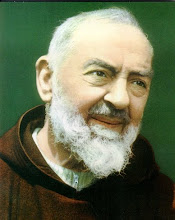
Next time I feel burdened by trials, my pain becomes unbearable, and I feel that God cannot be the all-good and all-loving God we believe Him to be, I’m going to grab this picture and look Him in the eye…

…and remind myself that no suffering is a pointless evil.
What are you going to do?
 A while back, I came across a facebook “like” page entitled, “101 Things to Do With Your Boyfriend/Girlfriend.” Upon reading it, I wasn’t very surprised to find that every other one of the things listed involved having sex, and the other 50% was simply cliché. I was teaching Theology of the Body for Teens at the time, and an idea occurred to me: what if the TOB students compiled their own list?

 Despite that, if these Catechism kids ever found their own orders, the world will be introduced to some wildly colorful habits; green ones, purple ones, and camouflage ones, among others. After all this lovely imagining, I dove into what I was there to talk about: discernment, and my experience of it.
 I wish that someone could have spoken to me about discernment when I was little. I wish that they had been there to remind me of that Openness to God’s Plan, which is all discernment is. Maybe then, I would have never gotten myself into such a mess over my vocation. After the age of four I learned what nuns really were. And though my admiration for the religious life was great, especially as exemplified by the saints, personal enthusiasm for it was drowned in the appealing prospect of being a veterinarian. By the time the notion of being a religious occurred to me again, I was thirteen and did not think that God could possibly be calling me to that. After all, He wanted me to be a famous author, right? So, I looked into third orders as a compromise. I’d be free to write books, God would have a sort of a vow, I’d have a community…it’d be great!
 Naturally, it didn’t work out, and I began to feel that God was asking something greater of me. So there I was, thirteen years old with no idea what discernment really was, thinking about maybe, possibly, not really telling my parents that I wanted to learn more about the Poor Clares. I essentially discerned discernment for quite a while. While I did this, I let myself fall in love with a guy (and I fell hard). Don’t worry—I was a ditzy fourteen year old, but not a sinful one. I never committed any crime except getting very, very attached to the guy. So, by the time this Poor Clare idea became a bit more than an itch, my interests and my heart each were sliced in half both ways. It wasn’t fun. It still isn’t, though I have a spiritual director helping me out now. I just wish sometimes that there had been someone there to remind me through the years that I do not know what God wants of me and that I need to be completely open to finding out. Maybe I would have never gotten into such a mess. Maybe I would have guarded my heart better, saved it for God until I was certain what God wanted to do with it. Maybe I would have given Him an honest chance from the beginning.

 They probably wouldn't get very far.